Saturday, 31 October 2015

M&M: The Devil's Backbone

Dear reader,

The Devil's Backbone from the year 2001 is another great movie by Guillermo del Toro. It's sort of the first part of Pan's Labyrinth, which I already wrote about. I saw Pan's Labyrinth first, so that's why I wrote about it “in reverse”, even though The Devil's Backbone came first. While Pan's Labyrinth was set shortly after the Spanish civil war (1936-1939), The Devil's Backbone is set in the time of the Spanish civil war.

The movie tells the story of Carlos, who arrives at an orphanage, which is far away from the city. He befriends some of the boys and learns that there's a ghost haunting the orphanage. The orphanage is led by Dr. Casares and Carmen. Both are Republican loyalists and keep gold for the Republicans. Jacinto working at the orphanage and was raised there. Now he wants the gold.

Over the course of the movie, we learn that Jacinto wanted to take the gold once before already, but one of the boys, Santi, caught him. Jacinto pushed Santi so hard that Santi fell and hit his head very much. To hide this act, Jacinto takes rocks and binds them to the body of the dying boy and throws him into a supply pool of the orphanage.

When the war comes nearer to the orphanage, Dr. Casares and Carmen decide to leave the orphanage with the children and the gold. Jacinto, who wanted to take the gold again, is chased away shortly before that. He comes back though and wants revenge by spreading petrol (gas) in the kitchen and setting it on fire. This leads to a big explosion in which some of the children as well as Carmen die. Dr. Casares is also injured and dies a short time later.

Jacinto comes back the next day for the gold. But the surviving children show a great amount courage and ingenuity, similar to Pan's Labyrinth, and fight against the adults. How and if they manage it, you'll have to see for yourself.

Much like in Pan's Labyrinth, The Devil's Backbone is created in a visually very beautiful way, I find. Although Santi is a ghost in the orphanage, I wouldn't say that The Devil's Backbone is a ghost movie. For me, strange as it may sound, it's more a movie with a ghost than a ghost movie. The ghost in his appearance is somewhat resembling a zombie with its slow an, awkward looking movements. He's got very little of the otherwise typical soft coloured see-through features of ghosts, but has dark colours instead and blood is still streaming from his head-wound in a sort of cloud of steam. Although a ghost is not a solid figure and, in theory, could not harm a person, his looks and manners appear somewhat scary and menacing. This only changes when it's obvious that he isn't dangerous deep down. A refreshingly different ghost from what I'm used to otherwise. And anyway: who or what is a ghost? What is a ghost outside the traditional literature or movies? That's a question which The Devil's Backbone is about.

The Devil's Backbone is all around a rather quiet horror movie and is more about atmosphere than effects. Fans of pools of blood and slasher movies will probably be disappointed. The very real horror doesn't come from the ghost, but from individual adults and because of the war. This is seen in similar ways later in Pan's Labyrinth.

To stay with the subject of the movie: what's the meaning of a ghost for you? Write that to me in the comments, if you like.

Until next blog,
sarah

Wednesday, 21 October 2015

Apophis

Dear reader,

Apophis is a near-Earth asteroid, which was discovered in the year 2004, in which it caused quite a fuss. At first it was assumed that it would get very close to the Earth. Now more data is known about it and the fly path was determined more precisely. The probability of a collision with the Earth is very, very slim to rather unlikely.

You may wonder now, when Apophis will come so dangerously or un-dangerously near? According to current calculations, it's going to be on April, 13 2029. Don't laugh, when I'm going to tell you which day of the week it's going to be: in all seriousness, it's a Friday, the 13th.

As a child, naturally I've been sceptical about Friday, 13th and bad things happening on those days. But when I was in primary school (elementary school, for my American readers), we had a rehearsal on a Friday, 13th, for a play of our recorder group and the rehearsal went without any problems. So I lost my fears about this specific day at a quite early age.

What could happen, if the asteroid does in fact come too close to the Earth or does in fact hit it? Well, that depends on the entry angle and the area of impact. If it's going to go down in deep water, we should expect high tsunamis. Although the asteroid has definitely potential to cause certain damage, should it hit the Earth, it's not expected to be a global catastrophe. Like I said, current status is that there's not going to be a collision anyway. I guess we'll literally have to wait and see what's going to happen on Friday, 13th 2029.

Until next blog,
sarah

Tuesday, 6 October 2015

Faster reading

Dear reader,

some readers have been more or less waiting for this entry. I hope I can finally help you now. I think that there is no “the one” method, to read fast or faster. With this entry I'd like to share with you some thoughts and introduce you to different approaches.

Some claim that it takes longer to form words with the mouth than to just see them with the eyes. I don't necessarily mean reading out loud with this. Also the unconscious forming of words in your head take time.

Generally you should have in mind what you want with the text and what you want to read it for. I have my own method to read fast and created it out of different ideas and suggestions. I don't know certain scientific words or expressions for kinds of reading. I only want to share ideas that helped me.

At university we had a seminar about working scientifically, in which the teacher told us that we should first check the headlines of a text for a first broad overview. Of course with books the table of contents is naturally helping with that. (With scientific texts or non-fictional writing, I realised that a look at the last pages or respectively lines of the text helps as well. Most good non-fictional books and scientific books anyway, have a list of references, where you can see how up to date the used literature is now. Depending on the topic I also like to check if certain authors and their works have found their way in or not.) The next good advice was, that the text immediately at the pictures or graphs talk about them. So you could skip that text and just look at the pictures and graphs and work them out on your own.

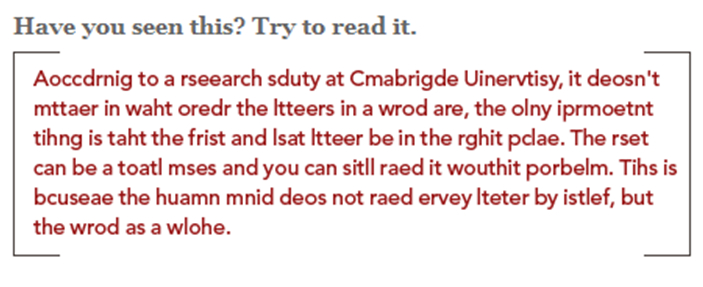
How much do you trust your unconscious to help you with reading and being useful? Maybe you know the following study already:


Depending on how well you are with reading, it's easier or harder to unrevel this “letter salad” of the study and reading it so it makes sense. Texts are generally not a letter salad like that and so it's easier to take those in then. At first it will be unfamiliar, but with experience you'll take in more and will be able to take in the words faster.

Maybe it was similar for you as it was at my primary school (“elementary school” for American readers). We were told to put our finger under the line respectively word we were just reading. For my method to read faster I use the bookmark turn it horizontally under the line I'm currently reading to go through it faster and not jump lines.

Some suggest to read a certain part of the beginning of a line and a part at the end of the line. Our brain would be able to sort of think up the middle part of it. Whether or not it's true, I don't know. My thought about this would be that with this method, I'd jump too much with my eyes. Namely from the beginning to the end to the beginning to the end of lines. My feeling tells me that a calmer movement of the eyes would be more comfortable for me.

The magician Derren Brown had a series years ago called “Trick or Treat”, in which he gave the applicants a blind choice between a positive experience (trick) or a darker one (treat). Glen Brighton is an ordinary man, who enjoys taking part in pub quizzes. Derren Brown signed him up for a certain one and wanted to prepare Brighton to make the first place. That means, he has to read a lot and take knowledge in at a very short and liminted time. For this Derren Brown lets him make a hand to a fist and then stretch out the index finger and pinky. Glen Brighton is only to concentrate on the area between the outstretched fingers. I personally favour that sort of eye movement down the middle part of a text, instead of concentrating on the beginning and end of a line. Also it's probably more text to sense and take in that way.

If you're interested in that episode: part 1, about 10 minutes: https://www.youtube.com/watch?v=ycHhiv5g_8k and part 2, also about 10 minutes: https://www.youtube.com/watch?v=DcVCrALes58.

I often use my bookmark in the way described above to stay in the line I'm reading and not explicitly reading every single word when going along that line with my eyes. It's not reading as such, more a visually taking in the words with the eyes. I guarantee you, that this method alone will make you take in faster. Trust that you don't need to read every single word exactly, to understand the content. You will notice individual important words anyway. Trust that you don't need every single detail, to understand the whole. Much like language teachers at school talk about not needing to understand every single word in a foreign language text or film. Start slow. Use the bookmark, like I do or to start with use your finger for individual words. Go through the line in a constant speed and take in the words without reading exactly.

If you need or want specific information from a text, be aware of the words. Have an image of the word in your head. And then it's like with those crosswords where there is seemingly letter salad in a square (German: Quadrat) and you are to find given words horizontally or vertically or whichever way. If you need to find the word “dog”, you don't need to go through every line looking for “dog... dog... dog...”, but look for “d” and if you've found a “d”, look around it for an “o”. If that's not the case, go to the next “d”. If it's got an “o”, look if it's followed by a “g”. That's quick, because it's just a square Quadrat with few letters.

For a longer text with sentences, it certainly makes more sense to search “bigger”. I'm quite certain that if you were to look for a capital letter “q” in the paragraph above, the word “Quadrat” will literally jump at you, even just roughly scanning the paragraph. Check that paragraph and trust your unconscious with that. The capital letter “Q” is an unusual enough word within a sentence, even in English where “q” is generally a more common letter than in German. But even if you're looking for a less unusual “c”, like for example in “crosswords”, you will find it within that paragraph. All you have to do is to have in mind what the “c” looks like. Have an image of the small letter “c” in your mind and do an image search. With a bit of exercise in this, you can also search unknown texts for information, even if it's not precisely in your head and irrelevant words vanish from your conscious perception. That happens quite automatically, just like when sometimes sometimes a word is written twice within a text, and when you read it unconsciously, you don't notice, only when someone points it out to you. Or did you notice that I wrote the word “sometimes” twice in the previous sentence? If you want, write that in the comments or also if those suggestions helped you.

Until next blog,
sarah

Wednesday, 30 September 2015

M&M: Wag the Dog

Dear reader,

especially with the crises and wars of the past months in several regions, we should, in my opinion, be more sceptical about the reports we believe and think how much and what to believe. Granted, the movie “Wag the Dog” from the year 1997 with Robert de Niro and Dustin Hoffman is satire and meant for entertainment. Maybe there's still a bit of truth in there also and could as well change your view of reporting and make you see it in a new light.

Imagine if you will that you're in America and it's shortly before a presidential election. Of course the current president wants to be president again. But suddenly he gets accused of having sexually harassed an under-age student. How could one lead the people away from this scandal? Conrad Brean (played by Robert de Niro) has an idea: a story, which leads to even more talking than a sex scandal would, which is a war. A war against which country though? Well, how much do you know about Albania? Probably as much as I do: which is nothing. So why not use this lack of knowledge and spread the rumour that America is at war against Albania. In a studio, with the help of Stanley Motss (played by Dustin Hoffman) some staged eyes witness reports are produced and get spread and the conflict with Albania is out on the news.

The CIA hears that the conflict is faked, and they go and have a serious talk with Brean, but he manages to talk himself out of it and save his own neck. Sadly, shortly after that news breaks out that the Albania conflict is solved. Brean and Motss however are enjoying their fiction so much and want to get the upper hand again. So they quickly invent a story about a lone soldier, who's still back in Albania and needs rescuing. His name is William Schumann, nicknamed “Old Shoe”. The story is supposed to be ending innocuously and sympathetically with the rescue of Schumann and return to America only days before the presidential election. Up until that point the movie is funny, entertaining and has moments of dark humour. It gets really exciting however when we learn that the actor, who is supposed to play Schumann, is in fact a high-risk offender. He gets flown in with a plane, to celebrate Schumann's triumphant arrival, but the plane crashes. Brean, Motss and the criminal survive the crash, but the psychotropic drugs that are supposed to keep him in check are slowly but surely wearing off.

How will the story of William Schumann end? You've got to watch it for yourself. By the way: it may be hard to believe with all the many similarities, but the movie was all finished when the ”Lewinsky scandal“ hit the news.

Until next blog,
sarah

Sunday, 20 September 2015

The sparkling inventor: Nikola Tesla

Dear reader,

I didn't enjoy Physics at school at all. Biology was more interesting for me and even the Chemistry basic course was enjoyable for me. We once made sparklers ourselves. Something I'd like to do again. It seems that at least some of the ingredients are not that easy to get your hands on as a normal person though, because they're classified as dangerous. Sad actually. I'd especially like to make sparklers that burn in other colours, but exactly those substances are the ones that are difficult to get. Also I'm not certain which of the ingredients are responsible for the colour and would need to be substituted. I hardly remember anything from my Physics class. I can remember we had to calculate stuff with formulas. What exactly we did calculate, I don't have the faintest clue anymore.

I caught up on a bit of Physics later on reading a couple of books by Stephen Hawking. I came across a special Physicist, Nikola Tesla, in the movie Prestige. In the movie he helps a magician. In the book, which I only read several years later, there's much more on what Tesla achieved. Of course the book and the movie tell a fictional story and what's happening in the book as well as the movie, could at least not have happened during Tesla's time. It's been several years since I got curious about Tesla after reading the book and I watched documentaries on Tesla on the internet. Most of the details I already forgot. But I promise you this: if a Physicist of Tesla's time had been able to do what happens in “Prestige”, then it would indeed have been Tesla. Just so you have an idea on what time we're talking about: Tesla was Serbian and lived from 1856 to 1943, so he lived when Thomas Edison was alive, too. In fact Tesla worked for Edison for a while. There's even a rumour that says that Tesla invented the light bulb, not Edison.

If you look at Tesla's life career, it seems to be characterised by a certain restlessness and reoccurring periods of lack of money. 1883 to 1884 Tesla was overseeing the installation of the new electrical light system at the train station Gare de l'Est in Paris and with that he was sort of working for Thomas Edison's European branch of the company. Without any means he travelled to America after that to work for Edison directly. But the two of them had different ideas of Tesla's payment, so the work relationship didn't last long. Tesla went on and got together with two other businessmen and found the Tesla Electric Light and Manufacturing Company. For some readers, who are more knowledgeable about this sort of stuff than I am, the two-phase electric power, may mean something. That's one of Tesla's inventions. With his new found company also started the registration of Tesla's first of many patents. As far as I know Tesla is among the people with the most patents. I heard some day that a Chinese or Japanese guy caught up and topped him now. The English Wikipedia reads “over 300 patents” as a number of Tesla patents in an article specifically on them.

Tesla was repeatedly lacking money. But the industrial magnate George Westinghouse heard of him. Westinghouse was in a dispute with Edison, which was later called War of Currents. I barely know anything about Tesla's personality. But I could imagine that Tesla found stimulation working with Westinghouse and in a way against Edison. Who knows.

In 1893 Tesla was approached and questioned how the powers of the Niagara Falls could be used. He suggested an alternating current system in cooperation with Westinghouse, which was then implemented. To use the powers of the Niagara Falls was a dream project for Tesla for a long time, which finally was finally reality.

There's something else that fascinated Tesla, which was the use of wireless energy. Tesla foremost thought about the sun as an energy source. But the earth is also surrounded by a magnetic field, which could be used as a source as well. More recent documentaries on the universe talk about antimatter, which supposedly can be used as a fuel for spaceships. For now we only know very little about this power. If only the machines existed to collect this energy and transform it for us to use as electricity. Free energy is seen as pseudo-science and there exist (conspiracy) theories that there are already scientists, who managed to build machines, but the knowledge about that is suppressed. I heard Tesla is said to have built such a machine, but destroyed it again himself. I don't know if those things are true or fiction. I like the idea that that energy is free and usable for everyone though. Sadly I know nothing about Physics really. Regardless of how many “knowledge about that is suppressed” stories are true, I do believe that this knowledge would be an actual threat to huge energy companies indeed. Because who would willingly pay even just a penny for electricity, if you can use energy that's free of charge and surrounds us, for free and unlimited?

Until next blog,
sarah

Thursday, 17 September 2015

Whoever has the choice has the torment

Dear reader,

"whoever has the choice has the torment", is how a German saying goes and it's true.

This is shortly before a mayoral election. This time it's not combined with a council election. For those of you here or if you have a political election in your area some time but don't know, who to vote for: go vote and give your vote to Scorch the dragon and partner of ventriloquist Ronn Lucas!

https://www.youtube.com/watch?v=jIYInw2y6IQ

Only a while ago I read that it's not that good to have many possibilities. Of course it seems at first bad when you only have one option. What if you don't like that option? Without at least a second option, you're forced to take that one option and be happy with it, even if you don't like it.

On the other hand, I once needed something to clean the plughole. Since I don't have that problem often, I stood there and was just overwhelmed by the selection of what felt like 20 things to clean the plughole. Something similar happened the first time I had to get more washing powder. Everything is advertised as the perfect one for your cloths. And which of the 40 powders do I actually buy now?

The solution is fairly easy for me when it comes to movies I see on the TV program for the night and I want to watch several of them and have to decide which to watch. Is one of them unknown to me? Chances are good that I will watch that one. Have I watched all of them already? Chances are good that I'll watch none of them and the TV will be off that night. Have I seen none of them already? Chances are good that I'll watch none of them and the TV will be off that night as well. I like movies. They're one reason for my M&M posts, to introduce you to movies I like once in a while. But I know that when there are several movies I know already or several unknown movies, it's just easier for me to decide to watch none of them. It seems simple, even laughable with movie options. One can't seriously talk about "stress" there. The fact is though that we're more relaxed, if we have only one option and don't have to make a decision.


In his article Why too much choice is stressing us out Stewart Jeffries describes a study where samples of jam were set out for customers to taste. If they bought a jar, they were also given a dollar coupon. One time they had 6 different samples of jam, another time they had 24 samples. 30% of the customers with the smaller set bought a jar, but only 3% of the customers with the larger selection bought one.


Until next blog,
sarah

Thursday, 10 September 2015

Magnetising magnetars

Dear reader,

everyone of us knows what a magnet is. But I myself have only recently heard of magnetars. To be clear: there are no known magnetars anywhere near to be a danger to us. So, whatever you'll read now and may get you scared: don't panic!

I understand very little about physics and astronomy, to tell you exact details anyway, so it can't get too scary today. Nevertheless I want to give you an idea of what I understand what a magnetar is. In the universe there are planets, meaning objects that move around, like the earth for example, going round itself as well as around the sun. Planets don't shine. The sun however is not a planet, but a star and stars do shine, but don't move. Stars like the sun have much energy, which at some point is used up. Some of you may certainly have heard the word supernova. That's what happens to a star when the energy is used up: the star shines one last time really bright, while it explodes and at least the shape and everything it had until then is destroyed. Sometimes the things left over after a destruction of the star with a certain strength of a magnetic field, turn into a neutron star, a magnetar.

Magnetars are relatively small stars, just about 10 to 30 km (12 mi) in diameter (which is about the size of a smaller city). They turn around themselves in an incredibly fast time. A rotation period is the time a planet takes to turn around itself to get to the starting position again. The rotation period of the earth is 24 hours. Magnetars are often found with partner stars. Wikipedia has as one of the rules to call a single star a magnetar, among other things, the rotation period of 1 to 12 seconds! Sure enough something small of 10 to 30 km in diameter can rotate around itself in a faster time than the earth anyway. Still I find 1 to 12 seconds for a rotation period pretty fast. Even though they're relatively small, magnetars have the mass of 40 times that of the sun!

The dangerous thing about magnetars for one thing are the x-rays and the gamma rays, which come up every now and then. X-rays aren't healthy for us anyway, which is why they try not to make a person take x-rays too often. Gamma rays are the shortest wave length we know so far and they're the most dangerous, too. Even if they don't kill us right away, they change the molecules and that kills us in the medium-term, similar to tumours. But not only that. When a magnetar is as far away from the earth as the moon, it's magnetic field would pull your coin money out of your trouser pockets. A magnetar half the distance of the moon and the earth would destroy the magnetic strip of your credit card forever. I don't even want to think any further about people with a pacemaker or other metal objects in them...

I can't tell you much more about magnetars actually. Like I said, I don't know much about physics or astronomy. I just find it fascinating to have learned about stars, which are just about the size of a city, but have considerably more mass than the sun and a strong magnetic field so it can pull your coin moneyout of your pockets. I'll tell you a little bit more about magnets and magnetic power anyway... in another blog post.

Until next blog,
sarah