Showing posts with label problems. Show all posts

Sunday, 6 January 2019

Beware of the red pen!


During the first couple of years at school, I remember we had moments where the teacher would read us a short text and we'd have to write it down to practise writing and spelling. I did pretty good back then. I barely made mistakes. I still have images in my mind of my writing being free from corrections and only at the end of it there would be a “Prima, Sarah!” (Great, Sarah!) For having no mistakes.

For my first two and a half years of school I lived up in Northern Germany. We had a text that had a sentence where I made a minor mistake about books on a shelf. During the Christmas break of my third year at school, we moved and I changed schools. In my new school we'd still write those texts the teacher was reading to us. Guess what? One time the teacher in my new school read the text about the books and I again I made the same mistake, that bit about the books on the shelf. That was in fact the only mistake I made that second time! My mother pointed out that I had made the same mistake the first time. I have no recollection of writing it the first time and how that went. But that's why I remember that sentence to this day actually: Not for writing it the first time, but for the mistake. The mistake I made twice, according to my mother.

I forgot where I read it. It's been a while. Part of the problem in the current school system and teaching system is that teachers focus on marking out what's wrong. Red pen marking out everything wrong. “Attention! Wrong!” If you're a good student making no or few mistakes, you're only left with a short, nice comment. If anything at all.

There seem to be teachers more recently, that let children write as they like and not correct them. That's what at least one co-worker once told me. Maybe some teachers don't want to discourage the children from writing by pointing out all the mistakes. But where would those end up that are in higher classes and still write the way they want to? There are certain set rules about how to spell and grammar and all that. You can't just ignore that. Sometimes you write different for certain effects and it's purposeful writing. Children need to learn the correct way first though. Or maybe the teachers are lazy? I've seen adults with bad writing, too. Also at a certain age hardly anybody points out mistakes. I don't know about the motivation of those teachers though. I hope there's more to this than... laziness?

How about instead encouraging the good students more and only focus on them? That way they'd feel pleased and confident to keep on doing what they do well. And the bad students might take interest in checking out how the good students do what they do well. Instead of the bad students feeling bad for their mistakes and the good students being only left with short comments? Just an idea.

Monday, 13 August 2018

Magical blow


Did you ever wonder what's so magical about blowing? As a child we blow out candles on our birthday cake and make a wish. As a child, after we hurt ourselves, mommy blew on the body part that hurt to make the pain go away (or at least lessen it).

Maybe, just maybe, adults would be a bit happier again, if they pursed their lips more often and let all the air out and make a wish. But it's got to be something you really want. Not just something willy-nilly, because I just told you to and you don't really want to. Go on. Make a wish. Inhale. Purse your lips. Exhale.

Let me know in the comments if your wish came true. Also let me know if you've got ideas about what's so magical about blowing.

Thursday, 9 August 2018

The wrong door


The other day I entered the tram through the right entrance next to the driver. The tram was pretty packed. At the very front and the very back it's also very cramped for my taste. Next to me was a young man. The next three stops the exit was on the left side. On the third stop a couple of people passed us to exit. When he noticed that he was where he wanted to go out, too, he approached the driver, “Could you...?”, pointing at the closed right door. The driver couldn't contain a grin. The young man noticed his mistake himself without the driver needing to say something and exited still on time.

Tuesday, 22 August 2017

Marcus Aurelius to keep you going in the morning

At dawn, when you have trouble getting out of bed, tell yourself: "I have to go to work — as a human being. What do I have to complain of, if I’m going to do what I was born for — the things I was brought into the world to do? Or is this what I was created for? To huddle under the blankets and stay warm?"

- "But it’s nicer in here..."

So you were born to feel ‘nice’? Instead of doing things and experiencing them? Don’t you see the plants, the birds, the ants and spiders and bees going about their individual tasks, putting the world in order, as best they can? And you’re not willing to do your job as a human being? Why aren’t you running to do what your nature demands?

- "But we have to sleep sometime..."

Agreed. But nature set a limit on that — as it did on eating and drinking. And you’re over the limit. You’ve had more than enough of that. But not of working. There you’re still below your quota.
You don’t love yourself enough. Or you’d love your nature too, and what it demands of you. People who love what they do wear themselves down doing it, they even forget to wash or eat. Do you have less respect for your own nature than the engraver does for engraving, the dancer for the dance, the miser for money or the social climber for status? When they’re really possessed by what they do, they’d rather stop eating and sleeping than give up practicing their arts.
Is helping others less valuable to you? Not worth your effort?

(Meditations Book V)

Tuesday, 25 July 2017

I don't like rain - yes, I do like it

There are sayings around the topic that not circumstances or situations are bad, but what's important is how we deal with them and perceive them. That sounds good and nice. Sometimes it's easier said than done. It's true though.

Last Wednesday it was hot and the postman complained. I told him that now everyone complains that it's too hot, but next time it's cold and wet again, everyone will complain again. This time that it's too cold and wet. I told him that I'd like it to be cooler, but don't like wet much. He said, he likes wet.

Thursday the cooling came and I had to go to work in the rain. I do not like umbrellas, because you've got 1) something in your hand and don't have it free and 2) what do I do with a wet umbrella? I prefer a wet jacket and hands free from umbrellas, dry or wet. Accordingly my jacket got wet on the way from my place to the train station. I had pulled my hood over the head. On the train I pulled the hood back off my head.

When I arrived at the stop at work, the rain hadn't stopped yet. Out of a somewhat strange feeling I didn't pull the hood back over my head. My hair got wet and suddenly I didn't care. No, it wasn't that I didn't care. It was good. I had been wrong on Wednesday. The rain got my hair wet. Inconvenient, since my hair curls up with a bit of natural curls I've got. It looks messy. Also no opportunity to dry the hair reasonably and fast either. At least I've got short hair.

I thought of someone in a movie, who over time has quite many scenes in which he gets more or less wet from rain. Sometimes he's got a hat. More than once he's got nothing to protect his head and hair. I thought of the actor and his character and the rain was suddenly perfectly fine and good. Strange how a simple mental connection can change the feelings for a situation.

No, I won't reveal which movie, actor or character I had in my head. That will stay my little secret. It's my connection anyway. If you don't like rain, you should find your own connection to make it likable. It can be liberating.

Tuesday, 6 October 2015

Faster reading

Dear reader,

some readers have been more or less waiting for this entry. I hope I can finally help you now. I think that there is no “the one” method, to read fast or faster. With this entry I'd like to share with you some thoughts and introduce you to different approaches.

Some claim that it takes longer to form words with the mouth than to just see them with the eyes. I don't necessarily mean reading out loud with this. Also the unconscious forming of words in your head take time.

Generally you should have in mind what you want with the text and what you want to read it for. I have my own method to read fast and created it out of different ideas and suggestions. I don't know certain scientific words or expressions for kinds of reading. I only want to share ideas that helped me.

At university we had a seminar about working scientifically, in which the teacher told us that we should first check the headlines of a text for a first broad overview. Of course with books the table of contents is naturally helping with that. (With scientific texts or non-fictional writing, I realised that a look at the last pages or respectively lines of the text helps as well. Most good non-fictional books and scientific books anyway, have a list of references, where you can see how up to date the used literature is now. Depending on the topic I also like to check if certain authors and their works have found their way in or not.) The next good advice was, that the text immediately at the pictures or graphs talk about them. So you could skip that text and just look at the pictures and graphs and work them out on your own.

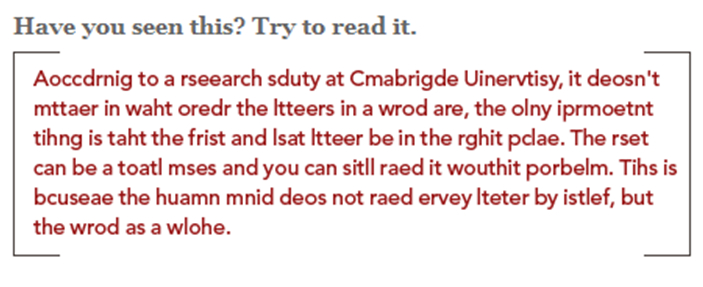
How much do you trust your unconscious to help you with reading and being useful? Maybe you know the following study already:


Depending on how well you are with reading, it's easier or harder to unrevel this “letter salad” of the study and reading it so it makes sense. Texts are generally not a letter salad like that and so it's easier to take those in then. At first it will be unfamiliar, but with experience you'll take in more and will be able to take in the words faster.

Maybe it was similar for you as it was at my primary school (“elementary school” for American readers). We were told to put our finger under the line respectively word we were just reading. For my method to read faster I use the bookmark turn it horizontally under the line I'm currently reading to go through it faster and not jump lines.

Some suggest to read a certain part of the beginning of a line and a part at the end of the line. Our brain would be able to sort of think up the middle part of it. Whether or not it's true, I don't know. My thought about this would be that with this method, I'd jump too much with my eyes. Namely from the beginning to the end to the beginning to the end of lines. My feeling tells me that a calmer movement of the eyes would be more comfortable for me.

The magician Derren Brown had a series years ago called “Trick or Treat”, in which he gave the applicants a blind choice between a positive experience (trick) or a darker one (treat). Glen Brighton is an ordinary man, who enjoys taking part in pub quizzes. Derren Brown signed him up for a certain one and wanted to prepare Brighton to make the first place. That means, he has to read a lot and take knowledge in at a very short and liminted time. For this Derren Brown lets him make a hand to a fist and then stretch out the index finger and pinky. Glen Brighton is only to concentrate on the area between the outstretched fingers. I personally favour that sort of eye movement down the middle part of a text, instead of concentrating on the beginning and end of a line. Also it's probably more text to sense and take in that way.

If you're interested in that episode: part 1, about 10 minutes: https://www.youtube.com/watch?v=ycHhiv5g_8k and part 2, also about 10 minutes: https://www.youtube.com/watch?v=DcVCrALes58.

I often use my bookmark in the way described above to stay in the line I'm reading and not explicitly reading every single word when going along that line with my eyes. It's not reading as such, more a visually taking in the words with the eyes. I guarantee you, that this method alone will make you take in faster. Trust that you don't need to read every single word exactly, to understand the content. You will notice individual important words anyway. Trust that you don't need every single detail, to understand the whole. Much like language teachers at school talk about not needing to understand every single word in a foreign language text or film. Start slow. Use the bookmark, like I do or to start with use your finger for individual words. Go through the line in a constant speed and take in the words without reading exactly.

If you need or want specific information from a text, be aware of the words. Have an image of the word in your head. And then it's like with those crosswords where there is seemingly letter salad in a square (German: Quadrat) and you are to find given words horizontally or vertically or whichever way. If you need to find the word “dog”, you don't need to go through every line looking for “dog... dog... dog...”, but look for “d” and if you've found a “d”, look around it for an “o”. If that's not the case, go to the next “d”. If it's got an “o”, look if it's followed by a “g”. That's quick, because it's just a square Quadrat with few letters.

For a longer text with sentences, it certainly makes more sense to search “bigger”. I'm quite certain that if you were to look for a capital letter “q” in the paragraph above, the word “Quadrat” will literally jump at you, even just roughly scanning the paragraph. Check that paragraph and trust your unconscious with that. The capital letter “Q” is an unusual enough word within a sentence, even in English where “q” is generally a more common letter than in German. But even if you're looking for a less unusual “c”, like for example in “crosswords”, you will find it within that paragraph. All you have to do is to have in mind what the “c” looks like. Have an image of the small letter “c” in your mind and do an image search. With a bit of exercise in this, you can also search unknown texts for information, even if it's not precisely in your head and irrelevant words vanish from your conscious perception. That happens quite automatically, just like when sometimes sometimes a word is written twice within a text, and when you read it unconsciously, you don't notice, only when someone points it out to you. Or did you notice that I wrote the word “sometimes” twice in the previous sentence? If you want, write that in the comments or also if those suggestions helped you.

Until next blog,
sarah

Thursday, 20 August 2015

Sleeping multi media and interactive

Dear reader,

with the tags/keywords sleep and sleeping problem, which I included here, you'll find my previous entries on what helps me when I want to go to sleep fast. Assuming I think about those methods. I want to make the entry today a multi media and interactive one.

For one thing, I'd like to introduce you to Holmes (actually a promo for the second season of "Elementary" with Jonny Lee Miller and Lucy Liu) the clip shows a series of methods of how Sherlock wakes up Joan in all sorts of different ways, although all of them could generally just be called "mean". The clip is meant as a sort of "When you've got problems waking up, use the Holmes system". Here's the clip:

https://www.youtube.com/watch?v=Y-aB2hU3axc

Fans of Benedict Cumberbatch certainly know the radio series "Cabin Pressure" by and with John Finnemore. He suffers repeatedly from insomnia, which lead to the piece "Insomnia Ballad" in his other radio series "Souvenir Programme". Here's the original (roughly 2 min. 19 sec.):

https://www.youtube.com/watch?v=OrYGSlEmt_I

Of course there are fans, who create their own version and publish that. I find that the musical is so well done, that I want to share it with you, too. It's a bit less than 3 minutes long and you can find it here:

https://www.youtube.com/watch?v=ZzSqubuZ7H8

And the interactive part? Well, that's your turn. What do you do, when you can't fall asleep? Or what could you suggest for others, who can't fall asleep fast or who can't fall asleep well? Anything is welcome, from music you like to listen to, to videos you have created to help others. Post it in the comments.

Until next blog,
sarah

Thursday, 25 June 2015

Organ language

Dear reader,

no, organ language isn't something bad or rude. It's the manner of expression of our organs, to show us that something isn't right. The theory goes that, based on which organ gives us trouble, we could also identify more precisely what kind of problem we have.

That doesn't seem that odd at all, although I have only very barely dealt with that subject. Some of it seems, even without deeper knowledge of organ language, almost intuitively finding expression included in our word-language, too.

The next time when you're thinking very hard about something, maybe also think of this entry and don't be too surprised that you've got a headache. Even though I can't tell you, why precisely you've got a headache from thinking a lot, there's still the phrase of “causing quite a headache”. Alternatively things can “cause somebody an upset stomach”.

Especially woman have fun when cooking, to also prepare the food on a plate in a nice way or enjoy it when someone serves them a meal that's set in a pleasing way, because “you eat with your eyes first”!

When once I was in the hospital for a surgery to correct my nose, many of us had tamponades in our nose and we joked some days after the surgery that we were “fed up” with it. Actually that one doesn't translate very well in English, because in German we say something like having a “full nose” literally.

Maybe you've heard of pheromones before, chemicals that are exchanged between two people and make us and the people next to us react to each other in certain ways. All of it is unconscious, but still there's some truth about the saying of “hating someone's guts”. Again, that one is a bad example in English, because in German we say that someone “smells good”, if we like them or doesn't smell good, if we don't like them. But still works in English with the “gut” as an organ in the saying.

Is it so surprising that some people develop asthma, when we've got the saying that something “takes my breath away” or something is “breathtaking”?

Maybe it's worth looking more into this organ language and what it may mean, especially if you've got problems with one or more organs time and again.

Keep a stiff upper-lip!

Until next blog,
sarah

Monday, 27 October 2014

The truth about too positive thinking: the bitter pill

Dear reader,

for the first time I prefer the german idiom (literally “the sour apple” or “biting the sour apple” actually) to the english “biting the bullet” or “swallowing the bitter pill”. Often I like the english idioms more. In this case though, fruit-wise, the german one fits better after my The lemon post than “biting the bullet” or “swallowing the (bitter) pill”. That's not the truth about too positive thinking. That's just something I noticed for myself and it doesn't even have to be the truth at all.


Gabriele Oettingen from the university of New York is researching self-regulation of goal setting and goal disengagement. In 2011 Oettingen and her colleague Heather Kappes did an interesting experiment. They deprived participants of the experiment of water. But they let them experience a guided visualisation exercise in which they pictured a glass of cold water. After that they measured the blood pressure and found that the exercise drained their energy and made them relaxed. They felt less compelled to actually get the real glass of water to satisfy their very real thirst.


Oliver Burkeman from the Guardian writes in his article How to be fitter, happier and more successful: stop dreaming and start getting real, that these findings are actually the reverse of what's very commonly known and assumed. Thoughts of the quite popular and well known The Secret come to my mind, which is full of examples of people more or less wishing for a positive future and then getting it.Gabriele Oettingen and her colleagues show that this intensive imagining is just one way to failure. A positive, new future doesn't come from “thinking up” a perfect world, but actually taking actions and that's other and new actions from what has been done before and brought unsatisfying results. Remember Albert Einstein's definition of insanity: doing the same thing over and over again and expecting different results. Therefore my idea of “thinking yourself thinner” as described in my Thinner too: with savvy - weight and see, was meaningless in the end. At least it's not the only way, if you want to be thinner. Especially girls or women can be seen again and again wearing tight cloths. At least that's not the only way to go, if someone wants to be thinner. In any case, there isn't just this one thing someone has to change or do to be thinner anyway. Tighter cloths can help in some ways. But what some, especially girls and women do, is not helping the “thinking yourself thinner”, but looking like a stuffed sausage and making it visible for everyone else just how not fitting those close are for them, which is certainly not at all the way to do it. Rethinking Positive Thinking: Inside the New Science of Motivation, Oettingen describes the WOOP method. WOOP stands for “wish, outcome, obstacle, plan”. On the WOOP homepage you can not only find more information like WOOP in 24 hrs to listen to and other downloads and help for interested people. WOOP is the idea that not everything is beautiful and perfect with thinking of it that way. The outcome, more specifically one specific outcome you imagine from that changed future helps. The very popular ignoring or “fighting your way” through obstacles may work sometimes. The second “o” (obstacle) in WOOOP and the “p” (plan) help making plans for what to do when ignoring isn't helping the reality and your original goal seems to fade away. That's how so many good ideas fall through after all: a missing plan for what to do when obstacles are there.


Until next blog,
sarah

Saturday, 27 September 2014

Remember not to forget

Dear reader,

I think Albert Einstein was right when he said, „The definition of insanity is doing the same thing over and over again and expecting different results.” Sadly this happens far to often and far to quickly when one is looking for something and can't find it. At least for me anyway. This happened again actually the day before yesterday.

Normally I keep a couple of things only at very few specific places and never anywhere else. I taught myself to do that automatically with my flat keys for example, to avoid looking for them for long and so I don't lose them. I keep the keys to my dad's flat, say, almost all the time in a certain backpack and in a specific inner pocket there. But a few days ago I had them in a different backpack, haven't been at my dad's, but I was in the neighbourhood and just in case, I had those keys with me. I did see those keys in this other, unfamiliar outside pocket several times the days before two days ago. I knew where they were. In the small outside pocket of the smaller backpack. I had seen them there the previous days again and again when I had the backpack in my hand and the outside pocket had been open. And yet I only checked the bigger pocket and also repeatedly(!) completely emptied the big backpack. It took me almost a quarter of an hour to finally take the small backpack again and for once also check the outside pocket to find the keys again.

Years ago I was looking for glasses once with blue tinted eyeglasses, which I have had. But did I have them still? In the past I had glasses at all times. Only a couple of years ago I started wearing them only occasionally. That's why I never used the sunglasses with the tinted eyeglasses. They didn't have the glasses I would have needed for my eyes sight. Did I have the glasses still? I checked every possible drawer of two specific cupboards in my room, also two drawers in the hallway. Several times. Because it's so much fun and suddenly the biggest things could have become tiny and hidden and be overlooked. I thought of Einstein checking everything the second time. After the third time I cursed myself for checking again, although I had found nothing the first two times already. I thought to myself, “I'll go to the living-room ask my mum. Maybe I don't even have the glasses anymore anyway. Checking a 100 times wouldn't help then. Maybe she knew something. Should I still have the glasses, I trust my unconscious and wish for to just walk up to the right drawer to find them there.” I went to my mum. She knew what I was looking for, but couldn't remember if we still had the glasses or not or where they might be. I went back to my room. Purposefully I stood in front of a commode where the guinea pigs and their cage were sitting on. There is only one drawer there where the glasses might be, in which I keep necklaces and earrings and also a big magnifying glass with a horn grip, too. If the glasses were there at all, it would be in that drawer. The other drawers had paper, note books and notes. I really pulled out the drawer this time and in the back of a corner there really was the small blue paper box in which I kept the blue tinted eyeglasses. I thanked my unconscious for guiding me to them that way.

Many scientists agree now that our brain never forgets and in theory we could remember everything that happened once. The individual information gets displaced by other information and new information and with that they fade into the background so much that we seemingly forgot them. Methods like the memory palace can help to organise and sort through thoughts and memories and find them faster, have them more “handy”.

Dr. John Watson gives a quite good description of how the memory palace works in “The Hounds of Baskerville” (Sherlock season 2, episode 2). Sherlock Holmes knows that he's got important information in his head “somewhere buried deep”. He tells John and Dr. Stapleton to get out, he'd go to his mind palace now.
“His what?”, asks Stapleton confused.
John explains to her, “Oh, his mind palace. It's a memory technique, a sort of mental map. You plot a map with a location, it doesn't have to be a real place. You deposit memories there. Theoretically, you never forget anything. All you do is find your way back to it.
“So this imaginary location could be anything?”, asks Stapleton. “A house or a street?”
“Yeah”, confirms John.
“But he said "palace"”, bursts out Stapleton. “He said it was a palace!”
“Yeah, well, he would, wouldn't he?”, says John almost a bit bored and maybe a bit annoyed that his friend has to boast with a palace in his head.

The way to information or memories is in fact important, too and doesn't have to be a mental walk or visual, seen in your mind. In “Dynamic Learning” by Robert Dilts and Tod Epstein, Epstein describes his work with an old lady. With her eyesight fading, she also had difficulties remembering certain things, which didn't cause problems before. Epstein noticed that the lad was visualising and thinking in pictures to retrieve memories. With fading eyesight, it became more difficult for her to see in hear mind. Epstein helped her getting back to memories through other senses. Which helped her memory getting better again, too. Before reading “Dynamic Learning” I only read in Thomas Harrison's books about the memory palace and after Derren Brown's “Tricks Of The Mind” I started creating a sort of system for myself. The suggestion that the way we retrieve information and that the senses we use for that are relevant as well, was new and an important aspect. It didn't change anything for me personally, not that I'm aware of anyway. Nevertheless it is something especially people working with other people, old people specifically, should keep in mind. Apparent memory loss doesn't necessarily have anything to do with not remembering.

Until next blog,
sarah

Monday, 18 August 2014

My wonder garden (or Sleeping fast part 2)

Dear reader,

I already wrote about what may help to go to sleep faster once (Sleeping fast... if you want it and remember...). Today I want to share with you a method, which has helped me some years ago. I don't use it much these days, because I can go to sleep fast and easy and the methods I described in my earlier post help me sufficiently enough. Nevertheless the one I like to tell you about today is also very effective. When I started using it, I didn't know it is actually a hypnosis method. Only later on when I read about hypnosis, did I recognise this method again. What I am going to describe now, is purely my own imagination. Of course you're totally free to change elements of it as you please and envision them.

I'd have my eyes closed and would imagine a staircase out of bricks in a building of bricks. Something like a hallway in a castle. The staircase were clearly visible, although the hallway wasn't lit as such. I never counted the steps and didn't walk them very consciously. Sometimes I would sit on the top step for a while and wait a moment, before standing up and starting to go down. Sometimes, after a few steps down, I'd just “be” at the bottom. At the end of the stairs there'd be a closed round wooden door with a door knob.

Behind the door is a garden with a path with a bend. The garden is blooming with lots of colourful flowers. The reader might enjoy bending down and take a sniff at some of the flowers. Are there butterflies in your garden, too? Let's go further down the path. First a bit more straight on. Then there's the bend. A bit further straight ahead. The path leads to a sitting area with a couple of chairs and a bench.

It's always a pleasure and surprise for me to see who's sitting there at the table waiting for me. Sometimes the two chairs that I have there are taken and also the bench has one or two persons sitting there. Sometimes there's just one person there. In any case never a person I really know, but always people I'd assume to be enjoying their presence or people I'd like to have conversations with or that might inspire me. Magicians like the “psychological illusionist” (as he calls himself) Derren Brown, who himself uses a lot of hypnosis and could “hypnotise” me to sleep. Although so far nobody spoke a word in my garden. Or Teller of the magic duo Penn & Teller. During performances he never speaks. If he does speak, it's always with his back to the audience or with his mouth covered. But on YouTube you'll find videos in which he does talk. So I do know his voice. In the garden he wouldn't speak though. Most of the time I'd find him there with a coin in his hand and he'd roll a coin across his knuckles. His decades of practise and experience make tricks like that look much easier than they are for me. With him it's a flowing movement and he could do it en passant. Charming. Bewitching.

After sitting there for a bit and watching Teller with the coin or just enjoying the presence of people there, I'd fall asleep. If the bench is free, I might lay down there and go to sleep in the garden and for real.

Like I already wrote above, you are free to create your own garden and take from mine what you like. Still I'd like to give you a couple of things to consider to get the best effect from this: 
  • If you want an exact number of steps to the door, I'd recommend 20.
  • Also I'd suggest to take a sniff in your garden and sense smells at least once, even if you don't specifically bend down to a flower. Far too often there's talk and suggestions only about visual aspects in exercises and methods like this. It's a fact however that we find it easier to get into a situation, the more senses are activated. Smell and taste usually are ignored. By smelling a flower, you'd have at least have smell in a bit once.
  • Of course a sitting area is no must have, neither is having one or more persons sitting there. Create your own surprises for yourself, like I keep surprising myself about who'd be sitting there.
  • For sort of “security reasons” I'd recommend to you, if you have persons, to make it people you don't know and are rather very unlikely to ever meet. Known persons may hurt or disappoint you some day. Those persons are not very likely to be in your garden anymore. Generally it's still better to not have people you know in places like that garden from the start. That way the garden is forever a safe place full of joy. 
My hypnosis friends (you know who you are) might have other suggestions to consider. Maybe I'll add more in my text depending on your comments or if I think of additional important aspects. For now that's it for me. I wish you much fun and joy in your garden and sweet dreams. If you like, you can share your experiences here.
Until next blog,
sarah

Tuesday, 10 June 2014

A vent (gut) post

Dear reader,

my blog is called "ventquest", because at the time of starting it, I was interested in ventriloquism, the gut in a broad sense. Not really on a quest as such though. It was more the fact that "quest" seemed close and funny enough to "quist" from "ventriloquist". Anyway, some days back I spent my evening... no, not in front of the telly, but on Youtube. One video followed another until finally I found one with the german title "Help with autism". I expected the "usual" autism being a "defect" in the brain, genetic, starting with healthy normal kids which then between 1 and 3 years getting "strange". Some are lucky and learn to communicate, others are fully dependent on others to care for them and can't speak.

Wrong for this movie. Partly anyways. This film tells the story of Adar Hassan with their sons, who came from somalia to america. Two of her sons are autistic. It started for one of them after he was treated with antibiotics for respiratory problems. She adopted the american ways of eating at first. But she found that when she cooked fresh food like she used to in somalia, her sons autistic expressions were less severe. Many immigrants found similar developments with their children.

But Ellen Bolte's son suddenly became autistic, too. She too lives in america. Her son was treated with antibiotics after an ear infection. Much like Adar Hassan's son, Ellen Bolte's son started with autistic behaviour after that. Ellen Bolte then started being interested in gut bacteria and found out some pretty interesting things. See for yourself:

http://www.youtube.com/watch?v=HGH1UD7uIQ4 (about 52 minutes running time) (Sorry for the subtitles, couldn't find any other version)

I wonder if disorders like ADD/ADHD may have similar causes. At least I see the treatment of that with tablets for "quieting" as worrying.

Giulia Enders studied medicine and is rather famous here in germany for her science slam about the gut. Very funny and entertaining. Sadly it's only in german. She also, rather unsurprisingly, published a book about that. That too is only in german. I do have another english clip for you though, which is a bit of a treat for you, because it only exists in english. Dr. Nancy O'Hara talking underlining the connection of the gut and autism in her presentation

Autism & ADHD: Healing From The Inside Out (about 21 minutes)

Until next blog
sarah

Friday, 31 January 2014

M&M: Gun Shy

Dear reader,

in 2000 the actor Liam Neeson had the leading role as the DEA agent Charlie in the film „Gun Shy“. Charlie comes back from an undercover mission, which has gone horribly wrong. It ended in a disastrous shooting, in which Charlie's colleague got killed and almost got him killed as well. Instead Charlie ended up head first in a water melon. Needless to say that he hates melons since then. From that moment on he has severe digestive problems as well as anxiety. There's nothing he wants more than retirement and the view of the ocean.

On his flight back, Charlie meets the therapist Dr. Jeff Bleckner (Michael Mantell). He notices how uncomfortable Charlie is and offers him help. Dr. Bleckner suggests Charlie goes to do some group therapy. During those sessions Charlie finds out that he's far from being the only one unhappy with his (professional) life. As he tells the others about his problems, he falls on sympathetic ears. Charlie has to take on one last job to stop the scary mafia boss Fulvio and his money laundering business. Charlie is so nervous meeting Fulvio the first time, that Dr. Bleckner prescribes him some pills. The therapist makes it very clear to Charlie only to take one pill. But Charlie is so nervous and the effect doesn't come fast enough for Charlie. So he takes a second. That leads to Charlie not only being calm during the meeting, but he very much not to fall asleep. In the end Charlie can't fight it any longer and just falls asleep in his chair as he is. Fulvio is enthusiastic and impressed how Chrlie can go to sleep and just sleep peacefully.

Charlie and Fulvio become friends for real. That's how Charlie realises that the mean mafia boss is just a show. Fulvio's wish for life is to grow tomatos. He only plays the mean mafia boss, because that's what everyone seems to expect him to be like. So Fulvio is just one more person, who is unsatisfied and with totally different dreams for how his own life should be. Charlie decides to help him.

Charlie consults the beautiful Judy Tipp (Sandra Bullock) about his digestive problems, who not only is able to help him with alternative medicine about his bodily problems. He's also infected by her optimism and the to of them come closer.

All in all this film can't be taken too serious and is far from what might happen in real life. But the film has much humour and it's much fun for me to watch all those great actors. The characters were written which much love and care, even the smaller parts and I enjoy it a great deal to see them all with their quirks and their problems they are fighting with and do their best to stick to their dreams and come closer to fulfilling them. At the end of this turbulent adventure especially Charlie and Fulvio clearly learned something for themselves and have been through quite some changes and achieved things for themselves.

Until next blog,
sarah


Friday, 20 December 2013

Postscript: Stop feeling sorry, but be compassionate!

Dear reader,

Susanne was so kind to point me to something very important about my last post: there's a difference between pity and compassion. I want to elaborate on that more now. Many thanks to Lisa as well for the stimulating chat!

For me pity is what I described in my last post. The professor has no arms. In my view, we need arms. She doesn't have arms, so I pity her. But as I already wrote, the professor at least seems to be happy, even without arms! So there is no reason to feel sorry or shocked or whatever for long. She's fine the way she is. It seems to me that pity has a lot to do with assumptions we make. Those assumptions should be tested and if possible lead to action of some kind or another afterwards. A bit like Sherlock Holmes. It would be bad to be stuck in an assumption and that was it.

Compassion is something different. With compassion someone might be shocked or startled at first. For example to learn that I'm missing my right foot. An important next step could be to ask, if or how I needed help. When I explain that I can walk, run and ride a bike fine, it's okay that I have got only one foot. I would need help swimming. Because I have to take off the prosthesis for that. That means that I have to get to the edge of the swimming pool or as close to the sea as possible with the prosthesis on, but then the prosthesis should be away from the water so it doesn't get wet all over. Then when I get out of the water I need the prosthesis back and someone either has to get it for me, or help me get to the prosthesis.

That's important and necessary. Generally speaking the professor and I are fine with our handicap. It's also fine to feel sorry for a moment that we lack arms respectively a foot. The important thing is how to react and deal with that in the longer term. That if we need help, we don't only have people around us who feel sorry for our situation and don't dare helping us or for whatever other reason don't act. When we need help some time, it's important for us to have people around, who understand and help us.

In the social field or among people working in communications there's a word often used: empathy. Recognise and understand what the other person is feeling. That may sometimes mean crying along with them. That's important and right. However it should happen for a limited time only. After that it's important to think it through together how things can go on from there. That's very important. Because if someone is really in a bad situation, that person needs help and not only someone to cry along with them. Even though the saying goes: A sorrow shared is a sorrow halved. It's even better if this sorrow has an end and one can get out of a bad situation easier and faster with others than alone.

Until next blog,
sarah

Stop feeling sorry!

Dear reader,

many people, especially those I meet on the internet, feel sorry when they learn that I was born handicapped. I'm missing my right foot from birth. But, as I keep telling those people all the time: I can walk normally, run, ride a bike with a prosthesis. Still the first reaction from many is, “I'm sorry.” Why anyway? Sometimes I say or write to them that probably they feel more sorry than I ever feel for myself. I was born this way. I don't know any other way. I don't miss my right foot. I never had it, but I always had a prosthesis.

Years ago, during my studies, I had some seminars with a professor with no arms. Although I never dared asking her directly, I assume she doesn't have arms because of Contergan. Once her son was in the seminar and she told us she's got a second son. In one discussion group in a seminar, she told us that she never had the need to put her arm around someone. The reaction of all of us at first certainly was shock. We're so used to hugging someone. Be it as a form of greeting or to comfort. And she has got two sons! Of course would I have the need to hug my sons, comfort them, put my arm around them, and cradle the little kid in my arm. Wouldn't I? And yet she seemed at the very least content with her life. She had said it herself, she never had had the need to put her arm around someone. Why then do I feel sorry for her, that she, especially with her two sons, could and can never put her arms around someone? I think, we're feeling sorry very quickly for others when we see or learn about something that's existing for us or possible for us, but not existing or not possible for them. But what good does it do to feel sorry then? Not at all.

My landlady and friends of my parents, consequently also mine, I guess, told me the other day that she was to give one of her sons money. That money was to come from another person, who didn't give it to her on time for her to give the money to her son on time. So when the son asked her about the money, she had to tell him she didn't have it... and said to him that she was sorry. Talking to me and thinking back about it, she questioned, why she had felt sorry about it. It hadn't been her fault that the other person didn't give the money on time!

Stop feeling sorry for yourself and especially stop feeling sorry for others! That's not helping anybody. When someone is in a bad situation, he or she needs help, not pity. If you want to help and the other person genuinely needs help, help them. That's all you can do. Everything else ends in you feeling sorry and then what? Then you feel bad yourself. That's not helping you or the other person.

Until next blog,
sarah

Wednesday, 2 October 2013

Sleeping fast... if you want it and remember...

Dear reader,

how about this: a night owl writes about how to fall asleep fast. Well, that's me right now, right here! I like the night, because it's quiet, calm and peaceful. The hectic of the day is gone. I get creative a lot of times at night.

Actually much like with my current way of dealing with pain, my fast sleep method is borrowed. It's an idea I heard from Richard Bandler. He says, the problem insomniacs have is that they give themselves bad suggestions. They talk to themselves in their head in a fast and hectic voice ("Talk to themselves in their head? I don't do that!" That's exactly the talking in your head I'm writing about.) and go on about "can't get to sleep" on and on. Of course you're never going to get to sleep that way! It comes close to the old "don't think of a pink elephant". Okay, you may also keep yourself awake thinking about the past or the future or both. Whatever it is, it's no good, because you're keeping yourself awake when you should sleep!

So Bandler's idea is to slow down your inner voice. I don't think I've talked about this to someone face to face yet. It was always online somehow. Lately what I think worked best as an explaination is to remind people of when one person starts yawning, you start yawning, too. So if you talk fast, you can't get to sleep. Slow down your inner voice, make it sleepy and you'll fall asleep with it.

If people say they have trouble falling asleep, I always ask them what's going on in their head. So I don't right away go into "slow down your dialogue". I had one person, who told me that she saw images in her head. Like a movie where she'd "replay" the day or see what would be happening the next day and stuff like that. I told her to slow down the movie. Make it slow motion, like they did with the Matrix movies in the fight scenes. Slow it all down. I don't know if Bandler ever suggested that. I only remember him talking about the dialogue. But it made sense to me to tell her to slow down the movie, if she had pictures in her head.

I sometimes lay in bed late at night and can't get to sleep, mind you. This technique is something that requires discipline. When I can't get to sleep, I don't look at the clock. I know it'll only make it worse. It'll start me going: "Oh my, it's x now. I really have to go to sleep now!" It's useless dialogue, so I don't even go there and don't check on the time. Instead I go: "There you are again. You know what to do." And even with the second sentence, I'll start slowing down. I may even go back to other thoughts I've been thinking, but it'll be slow and maybe a yawn or two as well...

Like with many other NLP techniques, it's all about hitting that point of "Stop it. I want something else." Sometimes it even takes me some time to get to that point. But when I do, I get to sleep quite fast from there on.

Until next blog,
sarah

Sunday, 4 August 2013

Hey, do you mind if I tell you a story?

Dear reader,

in the episode "The Rings of Akhaten" (Season 7, Episode 7) of Doctor Who, the Doctor wants to know more about Clara, whom he has met before in previous episodes and who seems somewhat odd. In this episode now they are on a planet where a girl, Merry Galel, is about to be sacrificed to an angry god. The Doctor doesn't give up on people easily, so he is desperate to find ways to help Merry Galel, too. They prepared her for the sacrifice from when she was very small and that's why she knows all the stories and songs of her people. But when she is about to be sacrificed, the Doctor comes and tells her something, which we all should be hearing more often, especially when we are desperate:

Hey, do you mind if I tell you a story? One you might not have heard. All the elements in your body were forged many many millions of years ago in the heart of a faraway star that exploded and died. That explosion scattered those elements across the desolations of deep space. After so, so many millions of years, these elements came together to form new stars and new planets. And on and on it went. The elements came together and burst apart, forming shoes and ships and sealing wax and cabbages and kings. Until, eventually, they came together to make you. You are unique in the universe. There is only one Merry Galel. And there will never be another. Getting rid of that existence isn't a sacrifice, it's a waste!

Until next blog,
sarah